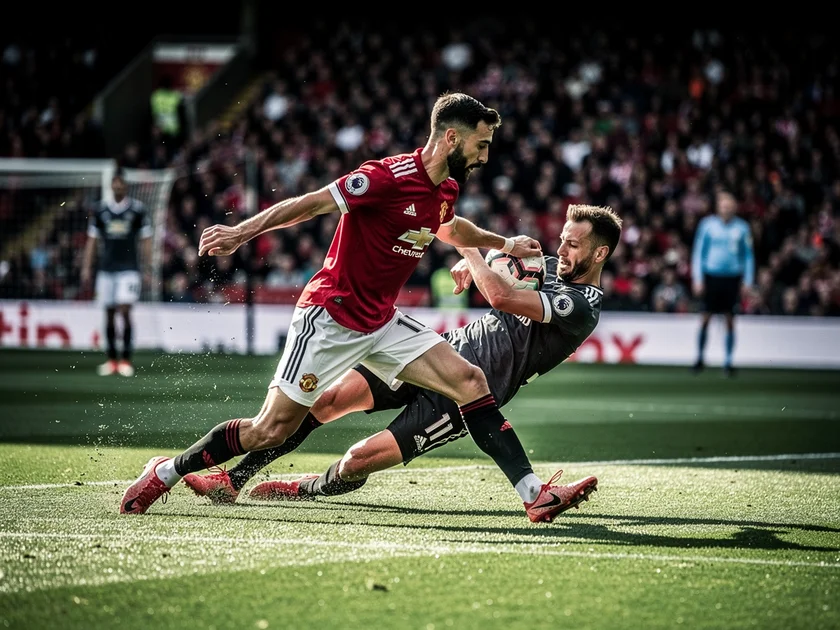
There is a particular kind of loneliness that comes with being the best player at a club in transition. In the spring of 2026, Bruno Fernandes knows it better than most. While Manchester United reshape their squad around a new identity, the Portuguese captain has stayed the fixed point — the man opposition coaches plan around, the player United’s build-up routes through. That he leads United’s 2026 form is no surprise. That he does it amid such structural uncertainty is the more telling story.
Bruno Fernandes leads Manchester United’s 2026 form at a moment when the club’s identity is still being written. His influence runs beyond individual stats. Fernandes acts as the connective tissue between United’s defensive shape and their attacking ambition — a role that demands technical excellence and the kind of leadership that shows up in training, not just match reports.
Manchester United’s 2026 campaign has unfolded against a backdrop of squad evolution. New faces have arrived. Familiar ones have left. The tactical framework keeps shifting. In that context, the consistency Fernandes provides carries weight that no single metric can capture. He is the player who knows where everything is supposed to go, even when the map is still being drawn.
The captaincy adds a layer of responsibility that colours every moment on the pitch. When United lose shape in transition, his voice reorganises them. When pressing triggers break down and opponents find space in the middle third, the recovery often starts with his positioning. The advanced metrics paint a picture of a player who has quietly absorbed more creative workload as the squad around him has shifted.
There is a counter-argument worth raising: a player as central as Fernandes can become a crutch. Over-reliance on one creative source makes a side predictable and easier to press. Opposition coaches who cut off his receiving lanes have found moments of success this season. The numbers suggest that when Fernandes is successfully isolated from build-up play, United’s expected goals output drops sharply — which speaks to his quality and to the depth question still hanging over this rebuild.
Why the Dependency Matters
Strip Fernandes from this United squad and you are not just removing a goalscorer. You are dismantling the club’s primary mechanism for turning possession into danger. That is not hyperbole — it is a structural observation backed by how United’s xG figures shift when he is absent or isolated.
Understanding what he means to this side requires looking beyond the goal contributions column — though that column stays impressive — and into the progressive passing sequences, the movement patterns, the set piece delivery. The numbers, tracked across three seasons, show a player never really allowed to be anything other than essential.
How Does Fernandes Compare to United’s Great Playmakers?
A Lineage of Load-Bearers
Bruno Fernandes sits in a lineage of Manchester United number tens who carried disproportionate creative responsibility during rebuilds. The comparison is not nostalgic framing. It reflects a structural truth about how elite clubs navigate transition, and how certain players become load-bearing walls when the architecture around them is still being built.
Eric Cantona transformed United’s trajectory in the early 1990s not simply through his own output but through the way his presence organised the attacking intent of those around him. Paul Scholes provided the progressive passing and spatial intelligence that linked United’s defence to their attack across nearly two decades. Wayne Rooney, during the post-Ferguson years, found himself in a position not unlike the one Fernandes occupies now — the most complete player in a squad searching for identity, asked to do more than his natural role demanded.
What sets Fernandes apart from some of those predecessors is the era he operates in. The modern Premier League demands pressing intensity and high-tempo transitions that place far greater physical demands on a playmaker than the game of the 1990s or even the mid-2000s ever did.
A number ten in 2026 cannot simply find space and use it. He must win the ball back, press the opposition goalkeeper, and still arrive in the right position to receive a progressive pass thirty seconds later. The film shows Fernandes completing all three within single passages of play. That is why his influence on United’s shape is so hard to replicate from the bench.
Where He Stands in 2026
Fernandes ranks among the Premier League’s most active playmakers in touches in the final third and set piece delivery during United’s 2026 campaign. That places him in company which, historically, has tended to produce the kind of numbers that define careers — and, occasionally, define clubs.
The modern demands on his position also mean the comparison with predecessors has limits. Cantona never had to press a back four. Scholes rarely tracked a fullback into his own half. Fernandes does both, routinely, and still produces at the top of the division’s creative charts.
The Tactical Architecture Bruno Fernandes Holds Together
The Build-Up Role
Manchester United’s build-up play in 2026 routes through Fernandes with a frequency that reflects both his quality and the lack of comparable alternatives in the squad. When United’s centre-backs carry the ball forward, they look first for the movement patterns of the Portuguese captain. He drifts, he checks, he creates the angle — and the sequence advances.
This is not simply a consequence of him being the most gifted player in the squad. It is a coached behaviour, embedded in United’s training ground work. The spacing United create in the middle third, the timing of wide players’ runs off the second ball, the moments when the striker drops to link play — all of it is calibrated around the expectation that Fernandes will be the central reference point. Remove that reference point and the geometry of the attack changes entirely.
Set Piece Delivery and Dead Ball Threat
United’s set piece threat in 2026 runs directly through Fernandes, both as a delivery specialist and as a direct threat from distance. His ability to whip the ball into dangerous areas from wide free kicks has been a constant feature of his time at Old Trafford, and the 2026 campaign has continued that trend.
The tactical importance extends beyond the obvious. Opponents who commit extra bodies to tracking Fernandes at set pieces create space elsewhere. His threat generates value even on deliveries that do not directly produce chances. That second-order influence is hard to quantify but straightforward to observe — the opposition is doing exactly the same calculation in reverse when they defend their own set pieces.
Pressing Triggers and Defensive Contribution
The modern playmaker’s defensive work has become non-negotiable at the highest level, and Fernandes has grown in this area since joining United in January 2020. His pressing intensity, never his most celebrated attribute, has developed into a genuine tactical asset.
When United’s manager sets a high press, Fernandes operates as the first line. His positioning determines whether the press has any chance of working — if the opposition plays through him easily, the rest of the structure collapses behind him.
An alternative reading deserves acknowledgment. The pressing demands placed on Fernandes can occasionally affect his availability in the final third during transitions. The numbers suggest a tension between his defensive workload and his attacking output on days when United press at maximum intensity for long stretches. That is a coaching dilemma any manager at Old Trafford must handle carefully.
What Do the Numbers Say About His 2026 Form?
The Statistical Profile
Bruno Fernandes in 2026 form represents the continuation of a statistical profile that has made him one of the Premier League’s most productive attacking midfielders since arriving at Old Trafford. The goal contributions column — goals plus assists — has been the headline figure throughout his United career, but the underlying numbers tell a more nuanced story about how his game has matured.
From United’s 2026 campaign, Fernandes continues to rank among the top performers in the division for progressive passes and touches in the attacking third. His expected goals involvement — combining his own xG with the xG generated by his key passes — places him in the upper tier of Premier League playmakers. He has held that position consistently enough that it can no longer be attributed to variance or a favourable run of fixtures.
Attribute
Bruno Fernandes (2026)
Premier League Playmaker Benchmark
Context
Role
Attacking Midfielder / Captain
Advanced Playmaker
United’s primary creative hub
Set Piece Delivery
Primary taker
Specialist role
Corners and advanced free kicks
Build-Up Involvement
High — central reference point
Variable by system
Coached into United’s structure
Pressing Contribution
Active — first line of press
Expected of modern no.10
Evolved since 2020 arrival
Squad Dependency
High — output drops when isolated
Elite players attract double coverage
Key rebuild consideration
What the Raw Figures Miss
The table above illustrates how Fernandes operates across multiple dimensions at once. What raw numbers cannot fully capture is the opportunity cost embedded in that multi-dimensional role.
A player doing this much across the pitch is, by definition, not conserving energy for the moments when his technical quality alone might be decisive. The numbers suggest that on days when United’s system functions cleanly — when the press works, the build-up flows, and set pieces land — Fernandes produces his best individual output. That is precisely because he is doing less connective work and more finishing.
That correlation between team function and individual output is the statistical story underneath the headline figures. It points toward a straightforward conclusion: Bruno Fernandes is not just a player who performs well when the team performs well. He is, in significant part, the reason the team performs well at all.
What Comes Next for Bruno Fernandes and United?
The Run-In and Beyond
The immediate horizon involves the final stretch of the Premier League season, where every point carries amplified weight in the context of European qualification. United’s position in the standings as of March 2026 determines the urgency with which Fernandes must perform — and the evidence from the club’s 2026 campaign shows the Portuguese captain treating the run-in as a maximum-effort period.
Three things define what comes next. First, United’s fixture schedule through April and May will test squad depth in ways that may require Fernandes to manage his minutes — a rotation call any manager must weigh against the reality that United are measurably worse without him. Second, the summer transfer window will shape the context in which he operates next season. If United address the creative depth question and sign a genuine alternative in his position, his role may evolve. If the rebuild continues without that addition, the 2026-27 campaign begins with the same structural dependency. Third, his contract situation — and the long-term planning conversations that surround any player of his age and status — will attract growing attention as the season concludes.
Bruno Fernandes has spent six years being the answer to questions Manchester United keep asking. The question for the next phase of this rebuild is whether the club can finally construct a squad sophisticated enough that he becomes one answer among several, rather than the only one that counts. Until that day arrives, Old Trafford’s creative architecture rests, as it has since January 2020, on the shoulders of the man from Maia.
Frequently Asked Questions
How has Bruno Fernandes performed for Manchester United in 2026?
Bruno Fernandes has led Manchester United’s form in 2026 as the club’s captain and primary creative force. He ranks among the Premier League’s most active playmakers in progressive passes, touches in the attacking third, and set piece delivery. United’s expected goals output drops sharply when opposition sides successfully isolate Fernandes from build-up sequences, underlining how central he remains to the club’s attacking structure.
What position does Bruno Fernandes play for Manchester United?
Bruno Fernandes plays as an attacking midfielder — commonly referred to as a number ten — for Manchester United, wearing the captain’s armband. In United’s 2026 system, he functions as the central creative reference point in build-up play, the primary set piece delivery specialist for corners and advanced free kicks, and the first line of the high press when United defend without the ball.
When did Bruno Fernandes join Manchester United?
Bruno Fernandes joined Manchester United in January 2020, arriving from Sporting CP in Portugal. Since his arrival at Old Trafford, he has established himself as one of the Premier League’s most productive attacking midfielders, consistently ranking among the division’s top performers for goal contributions — the combined total of goals scored and assists provided. By 2026, he has spent six full seasons as the club’s primary creative player and captain.
Is Bruno Fernandes the best player at Manchester United?
The evidence from Manchester United’s 2026 campaign points to Fernandes as the club’s most influential player in terms of creative output and structural importance. United’s build-up sequences route through him as the central reference point, their set piece delivery relies on his left foot, and their pressing structure depends on his positioning as the first line. No other current United player performs an equivalent volume of these functions simultaneously.
What are Bruno Fernandes’s strengths as a footballer?
Bruno Fernandes brings a combination of technical attributes that make him one of the Premier League’s most complete attacking midfielders in 2026. His primary strengths include progressive passing — advancing the ball through defensive lines — set piece delivery from wide positions, movement to create receiving angles in build-up play, and an evolved pressing contribution that has developed significantly since his January 2020 arrival at Manchester United. His expected goals involvement, combining personal xG with key pass xG, consistently places him in the upper tier of Premier League playmakers.