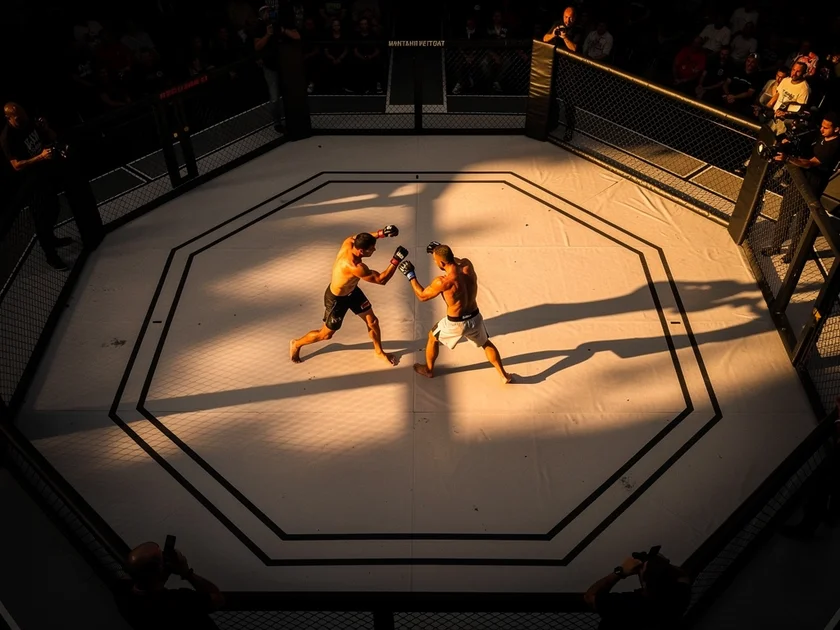
Sean O’Malley stands at a crossroads in the UFC bantamweight division as of March 2026, with the 135-pound landscape shifting rapidly around him. The former champion’s next move carries serious weight — both for his own legacy and for a title picture that has grown increasingly crowded since he lost the belt to Merab Dvalishvili at UFC 306 in September 2024.
O’Malley, known inside gyms as “Suga” for his fluid striking and unorthodox footwork, built one of the sport’s most recognizable brands during his championship run. Breaking down the advanced metrics from his title reign, his significant strike accuracy routinely exceeded 55 percent — well above the bantamweight average — and his ability to maintain distance with a 72-inch reach gave opponents almost no clean entry points on the feet. Those numbers still define how scouts and coaches evaluate his threat level heading into any future booking.
The Bantamweight Division After O’Malley’s Reign
Merab Dvalishvili’s rise to the top of the 135-pound class has reorganized the entire division’s hierarchy. The Georgian champion’s relentless wrestling volume — averaging more than six takedown attempts per 15 minutes across his UFC career — represents a stylistic nightmare for a striker like O’Malley, whose takedown defense, while improved, was exposed in their first meeting. The rematch conversation has never fully cooled among hardcore fans.
Below the championship tier, the division has deepened considerably. Cory Sandhagen, Umar Nurmagomedov, and Song Yadong have all staked legitimate claims to title contention, meaning O’Malley cannot simply wait for a direct rematch without risking a slide down the rankings. The UFC’s booking patterns suggest the promotion prefers its marquee names to stay active — typically no longer than a 10-to-12-month layoff before a ranked opponent is assigned or a fighter drops in the official standings.
O’Malley’s promotional value, however, gives him leverage that pure ranking math cannot fully capture. His pay-per-view drawing power during the championship run placed him among the top five PPV headliners in the UFC roster, a commercial reality that the front office brass factors heavily into scheduling decisions. That kind of box-office pull buys patience — but not indefinitely.
What Does Sean O’Malley’s Technical Profile Say About a Rematch?
Sean O’Malley’s striking craft remains elite at the bantamweight level, but the Dvalishvili blueprint exposed a specific vulnerability: sustained pressure combined with repeated level changes. Looking at the tape from UFC 306, Dvalishvili’s chain wrestling — particularly his ability to re-shoot after a stuffed attempt — consistently disrupted O’Malley’s rhythm and prevented him from establishing his preferred southpaw stance and distance management.
A credible path back to the title likely runs through at least one ranked opponent first, both to sharpen timing and to satisfy the UFC’s internal ranking protocols. Sandhagen, a fellow striker with elite submission defense and sharp boxing, would represent a stylistically fascinating and commercially viable option. Nurmagomedov, meanwhile, brings a Dagestani grappling pedigree that would test O’Malley’s ground defense in ways similar to — though distinct from — Dvalishvili’s pressure style.
The numbers suggest O’Malley’s chin has absorbed meaningful damage over his past two to three fights, a trend worth monitoring. His knockdown-to-absorption ratio shifted noticeably during the Dvalishvili loss, and any competent coaching staff preparing a future opponent will build a game plan around volume and physical pressure rather than trading power shots from range. O’Malley’s fight IQ is high enough that adjustments are plausible — but proving them inside the octagon is a different matter entirely.
Key Developments in O’Malley’s Career Trajectory
- O’Malley captured the UFC bantamweight title by knocking out Aljamain Sterling at UFC 292 in August 2023, ending Sterling’s dominant two-year reign.
- His first title defense came against Marlon Vera at UFC 299 in March 2024, a rematch of his only prior career loss, which O’Malley won by unanimous decision to avenge the 2020 upset.
- Dvalishvili dethroned O’Malley at UFC 306 — held at the Sphere in Las Vegas — in September 2024, with the fight going to a unanimous decision in favor of the challenger.
- O’Malley’s bantamweight title reign lasted approximately 13 months, spanning two successful defenses before the Dvalishvili loss ended his run at the top.
- His post-loss activity and public statements through early 2026 have pointed toward a return rather than a move to featherweight, keeping the 135-pound division’s rematch conversation alive.
Where Does O’Malley Fit in the 2026 UFC Landscape?
Sean O’Malley‘s commercial footprint gives the UFC strong incentive to rebuild him carefully rather than rush a high-risk booking. The promotion has historically protected its biggest PPV names with strategic matchmaking — giving fighters one or two ranked wins before cycling them back into championship contention. Based on available data and the current bantamweight rankings, O’Malley likely needs a single ranked win to re-enter the title conversation, assuming Dvalishvili remains champion and no other contender leapfrogs the queue.
His training camp at MMA Lab in Arizona has long emphasized striking refinement over wrestling development, which raises a fair counterargument: unless O’Malley’s team commits serious mat time to improving his scramble defense and bottom-position escapes, a rematch with Dvalishvili carries the same structural risk as the first fight. Stylistic adjustments take months of drilling to internalize under pressure — they don’t arrive simply by watching film.
Still, dismissing O’Malley’s adaptability would be premature. He arrived in the UFC as a flashy prospect with questions about his durability, then answered most of them during a championship run that included a decisive performance over Vera and a landmark knockout of Sterling. The bantamweight division in 2026 is richer and more competitive than it was during his title reign — which, paradoxically, makes O’Malley‘s next chapter more compelling to watch unfold.
When did Sean O’Malley lose the UFC bantamweight title?
Sean O’Malley lost the UFC bantamweight title to Merab Dvalishvili at UFC 306, held at the Sphere in Las Vegas in September 2024. The fight went the full distance and Dvalishvili won by unanimous decision, ending O’Malley’s roughly 13-month reign as champion after two title defenses.
What is Sean O’Malley’s record and fighting style?
O’Malley is a southpaw striker who fights out of a wide stance, using a 72-inch reach to control distance and land high-accuracy combinations. His significant strike accuracy during his title reign exceeded 55 percent. He trains primarily at MMA Lab in Arizona and is known for creative footwork and precise counter-punching rather than volume output.
Who are the top contenders in the UFC bantamweight division in 2026?
As of March 2026, the 135-pound division’s top contenders include Umar Nurmagomedov, who carries a Dagestani grappling pedigree, Cory Sandhagen, a versatile striker with elite submission defense, and Song Yadong, who has steadily climbed the rankings with consistent finishes. All three represent legitimate obstacles between O’Malley and another title shot.
Has Sean O’Malley ever moved up to featherweight?
O’Malley has not competed at featherweight (145 pounds) during his UFC career and has publicly indicated a preference to remain at bantamweight through early 2026. The weight cut to 135 pounds has not been cited publicly as a major issue for him, unlike some other fighters in the division who have explored moving up.
What was Sean O’Malley’s first UFC title win?
O’Malley knocked out Aljamain Sterling at UFC 292 in Boston in August 2023 to claim the bantamweight title. Sterling had held the belt since 2021 and was considered a heavy favorite going into the bout. The finish came in the second round and represented one of the biggest upsets — and career-defining moments — in recent bantamweight history.