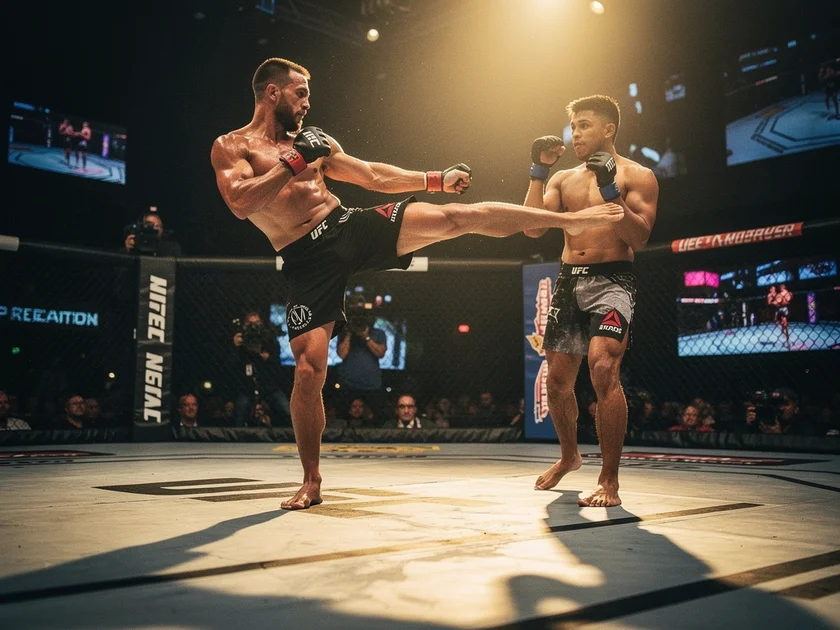
UFC Fight Night Results from the Meta APEX in Las Vegas on April 4, 2026, thrust the lightweight division back into focus as No. 10 ranked contender Renato Moicano faced Chris Duncan in the main event. The card drew rankings watchers who have followed Moicano since his title-challenger days at 155 pounds.
The prelims carried their own storyline. Veteran lightweight Kai Kamaka III returned to the Octagon for the first time since 2021, squaring off against Houston newcomer Dakota Hope, who entered at 11-1. Five years away from UFC competition raises hard questions about ring rust and cardio — two things that forgive nobody at lightweight.
What Happened at the April 4 Las Vegas Card
Saturday’s event took place at the Meta APEX in Las Vegas. Moicano headlined as the No. 10 ranked lightweight contender against Duncan. The UFC structured the card as a lightweight showcase, spreading multiple 155-pound bouts across both the preliminary and main card portions.
Renato Moicano entered carrying the credibility of a former title challenger. He has shared the Octagon with elite competition and understands how thin the margin for error runs near the top of the lightweight rankings. Duncan represented the hungry challenger type the UFC uses to stress-test contenders. Championship pedigree against a fighter eager to announce himself — that framing made this a genuine rankings-relevant main event.
Moicano’s ground game and submission threat have historically been his sharpest tools. His fight IQ lets him control pace against strikers. Duncan’s takedown defense — and how long he could neutralize a Brazilian jiu-jitsu specialist of Moicano’s caliber — stood as the central technical question heading into the bout. Film on both fighters showed the clearest path to a finish ran through the clinch and the first takedown attempt.
Kamaka III Returns: Prelim Breakdown
Kai Kamaka III’s comeback was the most emotionally charged subplot on the preliminary card. The Kapolei, Hawaii native faced Dakota Hope, a lightweight out of Houston with an 11-1 professional record. Comeback bouts carry real risk at this level. The UFC’s 155-pound division does not slow down, and Hope’s near-unblemished mark signaled he would not offer a soft re-entry.
Kamaka III carried a 17-7-1 record into the fight — a ledger built through years of hard UFC competition during a stretch when 155 pounds was arguably the promotion’s deepest weight class. His Kapolei, Hawaii roots connect him to a regional combat sports culture that has sent several fighters to the UFC. Hope, at 11-1, brought the kind of momentum that either becomes a launch pad or hits a ceiling fast, depending on how quickly a prospect absorbs the UFC’s pace and pressure.
The numbers reveal a sharp contrast between the two men. Kamaka’s 17 professional wins came against seasoned opposition; Hope’s 11 came with the polish of a prospect still building his resume. One draw on Kamaka’s record — a rarity at the UFC level — reflects the competitive depth he has faced across his career.
UFC preliminary cards built around comeback narratives tend to resolve one of two ways: the returning fighter validates his durability, or the prospect’s rise gets accelerated. Both outcomes carry real weight in a division where depth makes every result consequential.
Key Developments From the April 4 Card
- Moicano’s No. 10 lightweight ranking made Saturday’s main event a direct top-10 positioning contest — one of the cleaner rankings stakes on any spring Fight Night card.
- Kamaka III last competed at the UFC level in 2021, giving his return a measurable gap of approximately five years.
- Hope’s 11-1 debut record ranked among the stronger marks brought into a UFC prelim slot in recent memory, adding legitimate upside pressure on Kamaka.
- The Meta APEX gives the UFC full command over broadcast production and event logistics, a controlled environment unavailable at public arenas.
- The UFC promoted the Moicano-Duncan matchup as an “all-action” lightweight main event — a label reserved for bouts where both fighters carry finishing ability.
What These Results Mean for Lightweight
UFC Fight Night Results from the Moicano-Duncan card carry direct implications for the 155-pound picture. A Moicano win cements his spot as a genuine top-10 threat and pushes his name toward title eliminator conversations. A Duncan upset drops a fresh name into serious contention — the kind of result that forces multiple fighters to recalculate their positioning at once.
Moicano’s former title-challenger ceiling is rare among fighters at his current ranking. Whether his consistency against motivated opponents outside the true elite holds against a driven challenger like Duncan is the sharper analytical question. The numbers heading into April 2026 favor Moicano on experience, but experience is a depreciating asset when a younger fighter is closing fast.
Renato Moicano has built one of the more durable careers in the UFC’s lightweight division over the past six years. He absorbed a tough title-fight loss, rebuilt his record, and re-entered the top-10 conversation through patient matchmaking and decisive performances. His submission game — rooted in a black belt-level Brazilian jiu-jitsu foundation — remains a constant threat regardless of how the stand-up portion of a fight unfolds. Against Duncan, whose UFC record was still being established heading into April 2026, Moicano’s mat credentials gave him a clear finishing path that Duncan had to account for from the opening bell.
Kamaka III’s performance adds a fresh data point to the ongoing conversation about UFC veterans returning after long breaks. The promotion has shown willingness to rebook fighters when name recognition and fan interest justify the matchmaking. How Kamaka’s cardio held across rounds, how his submission game translated against a fresh prospect, and whether he looked physically sharp will shape future 155-pound booking decisions.
Every card at the Meta APEX functions as a live audition. The April 4 slate was no different. Fighters watching from home, managers negotiating next bouts, and the UFC’s matchmaking brass all parse these results with one question: who moved the needle, and who needs a different assignment?
Where did the Moicano vs Duncan card take place?
The April 4, 2026 event was held at the Meta APEX in Las Vegas, Nevada. The Meta APEX is the UFC’s dedicated production facility — a compact, controlled arena used exclusively for Fight Night cards. Unlike public venues, it gives the promotion full command over broadcast quality, lighting, and event pacing, which is why the UFC defaults to it for non-pay-per-view programming.
What is Renato Moicano’s UFC ranking heading into the Duncan fight?
Moicano entered the April 4 main event ranked No. 10 in the UFC lightweight division. That placement put the bout squarely in top-10 territory. His prior run as a title challenger — including a fight against a then-champion at 155 pounds — gives him one of the stronger championship-level resumes among fighters currently positioned in the lower half of the 155-pound top 10.
Who is Dakota Hope and what is his professional record?
Dakota Hope is a lightweight fighter based out of Houston, Texas, who entered his UFC bout against Kai Kamaka III with an 11-1 professional record. Hope was classified as a UFC newcomer for the April 4 card. His debut came against a fighter in Kamaka who holds 17 professional wins, meaning Hope faced genuine experience on his first night inside the Octagon — a steep entry point by any measure.
How long had Kai Kamaka III been away from UFC competition?
Kamaka III had not competed in the UFC since 2021, making his April 4, 2026 appearance his first promotional bout in approximately five years. His 17-7-1 record includes that uncommon draw — a result that reflects the caliber of opposition he faced during the UFC’s most competitive stretch at lightweight. Fighters returning after multi-year gaps typically face heightened scrutiny from matchmakers on conditioning and timing.
What weight class dominated the April 4 card?
The April 4, 2026 card at Meta APEX was built primarily around the lightweight division at 155 pounds. The UFC promoted the event as an “all-action lightweight” showcase and stacked the preliminary card with additional 155-pound bouts. That concentration of lightweight talent made the evening a de facto ranking exercise, with multiple fighters’ positioning subject to change depending on how the results stacked up across the full card.