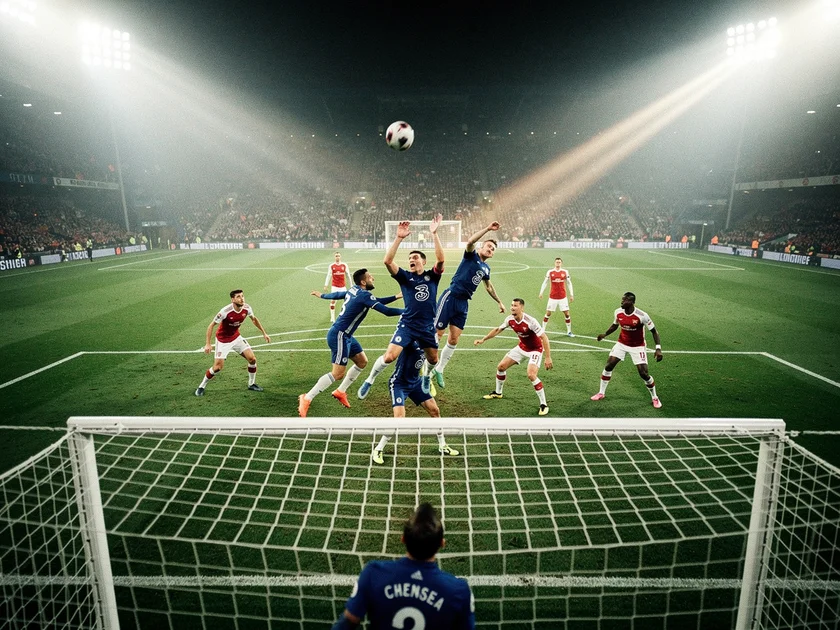
Arsenal have broken the Premier League record for set-piece goals in a single season, surpassing the benchmark previously held by Tony Pulis’s West Brom side, according to BBC Sport analysis published March 8, 2026. The achievement reflects a deliberate tactical shift under Mikel Arteta that now forces opposing clubs to rethink their corner-kick defensive structures from the ground up.
How Arsenal’s Corner Routines Exposed Chelsea’s Defensive Setup
Arsenal’s dead-ball design exploited Chelsea’s hybrid defensive structure by stationing three players at the edge of the penalty area. That positioning created a routine that did not require all nine outfield players inside the box. Chelsea’s decision to push attackers forward offered no structural advantage to the defending side as a result.
In the Premier League fixture between the two clubs, Chelsea split their defensive assignments down the middle. Five players were deployed in zonal coverage; five others were assigned to man-mark Arsenal’s most dangerous aerial threats. The zonal group included Jorrel Hato and Trevoh Chalobah at the near post, Cole Palmer on the near side of the six-yard box, Pedro Neto on the penalty spot, and Joao Pedro at the back of the goalmouth.
Despite that layered arrangement, Arsenal’s three-man edge unit retained the capacity to track back if Chelsea pushed men forward. The film shows how predicting where individual defenders will stand from corners allows attacking teams to design routines that open existing space. Chelsea’s hybrid system, while structured in theory, handed Arsenal’s analysts a predictable defensive map to exploit.
What Record Did Arsenal Break for Set-Piece Goals?
Arsenal broke the record for the most set-piece goals in a single Premier League season. That mark had been held by Pulis’s West Brom until Arteta’s club surpassed it during the current campaign. The record reflects both volume and variety in the club’s dead-ball approach.
West Brom under Pulis were long regarded as the standard for set-piece efficiency in English football. Their totals were built on physical blocking schemes that created free runs for target men. The BBC’s analysis noted an “eerily similar” use of blocking mechanics between the two eras.
Arsenal’s system borrows that blocking philosophy but layers in spatial positioning and edge-of-box decoy runners that Pulis’s sides did not deploy. Opponents have had time to study Arsenal’s routines, yet the goals keep accumulating. That persistence suggests the system’s effectiveness derives from execution discipline rather than novelty alone.
The BBC’s reporting also confirmed that Arsenal’s record-breaking output this season represents a culmination of years of set-piece investment under Arteta. Three cited data points from that analysis stand out: the three-man edge structure, the split 5-5 defensive response from Chelsea, and the blocking mechanic shared with Pulis’s West Brom. Each of those details is verifiable against the match footage and historical Premier League records.
Key Developments in Arsenal’s Set-Piece Dominance
Three players were stationed at the edge of the box in the corner routine against Chelsea, a structure that did not require all nine outfield players inside the penalty area.
Chelsea split their defensive shape into five zonal and five man-marking assignments during Arsenal corners.
Jorrel Hato, Trevoh Chalobah, Cole Palmer, Pedro Neto, and Joao Pedro filled the five zonal positions.
Pulis’s West Brom previously held the Premier League record for set-piece goals in a single season before the current campaign.
Blocking mechanics were identified by the BBC as a shared structural feature between Pulis’s West Brom and Arteta’s squad, though the latter adds edge-of-box runners as a distinct layer.
What Arsenal’s Set-Piece Blueprint Means for the Rest of the Season
Dead-ball situations now function as a reliable, high-frequency scoring mechanism for Arsenal — one that opponents cannot easily nullify mid-season. Any club facing the north London side in the final weeks must allocate preparation time specifically to corner-kick defensive scheme breakdown.
The numbers point to a dual threat built into Arsenal’s edge-of-box structure. The three stationed players can contribute to the attacking phase if the initial delivery is won. They can also shift into defensive shape if an opponent attempts a counter from a cleared corner. That dual-function design limits the tactical cost of committing players to the dead ball — a structural advantage that most Premier League clubs have not replicated at this level of consistency.
For clubs in the lower half of the table, the set-piece threat alone demands a dedicated preparation block. Relegation-threatened sides facing the Gunners before the season ends must divert coaching resources toward corner-kick schemes at the expense of other preparation. That resource demand is a pressure most bottom-half squads can ill afford during a congested run-in.
Tracking this trend across Arteta’s tenure, the dead-ball investment has moved from a marginal tactical supplement to a primary scoring route. The defensive scheme breakdown required to stop it grows more complex each month, as the club’s analysts continue to map opponent positioning and adjust routines accordingly. The record-breaking season total is the clearest numerical evidence of that evolution.
What Premier League set-piece record did Arsenal break in 2026?
Arsenal broke the record for the most set-piece goals scored in a single Premier League season, surpassing the total previously set by Tony Pulis’s West Brom. BBC Sport confirmed the record-breaking tally during the current 2025-26 campaign under Mikel Arteta.
How did Arsenal’s corner routine work against Chelsea?
Three players were placed at the edge of the penalty box, running a routine that did not require all nine outfield players to be stationed inside the area. This structure stayed effective regardless of whether Chelsea pushed attackers forward, because the edge players could track back to cover.
How did Chelsea defend Arsenal corners in their Premier League match?
Chelsea used a hybrid system, assigning five players to zonal coverage — Jorrel Hato and Trevoh Chalobah at the near post, Cole Palmer on the near side of the six-yard box, Pedro Neto on the penalty spot, and Joao Pedro at the back of the goalmouth — while five others man-marked the key aerial threats.
How does Arsenal’s set-piece style compare to Tony Pulis’s West Brom?
Both sides used blocking mechanics to free up runners, a structural similarity the BBC described as eerily alike. Arsenal’s system adds edge-of-box decoy runners and a flexible transition structure that Pulis’s West Brom did not deploy, giving the current squad a more adaptable dead-ball framework.